Pages

Thursday, May 9, 2013

Kamaruzzaman to hang


A war crimes tribunal has ruled that Jamaat-e-Islami leader Mohammad Kamaruzzaman must die for the crimes he committed in 1971 against Bengalees fighting for the birth of Bangladesh.
A former head of Jamaat’s diplomatic relations and liaison team, this former Al-Badr man committed crimes at the age of 19 when he was a local leader of Jamaat’s erstwhile student wing, the Islami Chhatra Sangha, in and around Sherpur.

Justice Obaidul Hassan-led International Crimes Tribunal-2 gave out the verdict.

The Jamaat itself perpetrated war crimes – listed by the Guinness Book of Records as among the five deadliest 20th-century killing – during the war against Pakistan and facing widespread call for being outlawed as a political party.

Justice Mohammad Shahinur Islam began reading the 62-page summary of the 215-page verdict at 11:21am in an overcrowded courtroom, bdnews24.com Correspondent reported.

Judge Md Mozibur Rahman said five of the seven charges levelled against him had been proven.

He said, according to the charges brought by the prosecution, Kamaruzzaman was the ‘chief organiser’ of the Al-Badr, a militant outfit formed to assist the Pakistan army to thwart Bangladesh’s freedom struggle in 1971, of greater Mymensingh region.

The prosecution had presented a report run by the Jamaat mouthpiece Daily Sangram during the war to support its allegation.

Judge Rahman said the defence had failed to prove otherwise.

Charges of Genocide at Sohagpur, torture of lecturer Abdul Hannan, muder of Golam MOstafa, and the murder of five were proved.

The verdict said that the charges of killing eight against Kamruzzaman could not be proved beyond doubt.

Kamaruzzaman was brought to the courtroom at 11:45am. Five minutes later the judges arrived.

Chairman of the International Crimes Tribunal-2, Justice Obaidul Hassan, thanked the lawyers of both prosecution and defence, and began reading out the details of Kamaruzzaman’s case.

Justice Mohammad Mojibur Rahman Mia read out the second part of the verdict with ICT-2 Chairman giving the final verdict.


Kamaruzzaman was clad in a white shirt and black trousers. When brought, he headed straight to the place designated for him without looking anywhere. His oiled hair was brushed neatly, and was not wearing a cap.

Freedom Fighters, eminent personalities and leaders of Ghatak Dalal Nirmul Committee were seen at the International Crimes Tribunal (ICT) premises despite a drizzle on Thursday morning, awaiting the verdict of Jamaat-e-Islami leader Mohammad Kamaruzzaman.
The three-member judge panel of ICT arrived at the court premises at around 10:00am.

Media, lawyers, and many others from various walks of life were gathering at the tribunal premises since morning, bdnews24.com Correspondents at scene reported. Jamaat’s Assistant Secretary General Kamaruzzaman was brought to the tribunal from Dhaka Central Jail at around 9:30am.

Ghatak Dlal Nirmul Committee chief Shahriar Kabir, Professor Muntasir Mamun, Sammilita Sangskritik Jote President Nasiruddin Yousuf Bachchu were present at scene and were talking to journalists. They were all hoping for capital punishment for Kamaruzzaman and all war criminals.

Muktijoddha Sangsad Central Command Council members arrived at tribunal premises with national flags and their own flags at around 10:45am. Council Chairman Retired Major General Helal Morshed Khan was seen leading them.

They were chanting slogans demanding execution of war criminals.

Special security arrangements were made at the tribunal premises, Ramna zone police Assistant Commissioner (patrol) Imanul Islam told bdnews24.com. Traffic has been curbed through Doyel Chattar, Kadam fountain and other areas.

Police and Rapid Action Battalion (RAB) were seen alert outside the tribunal premises.

ICT-2 started hearing Kamaruzzaman’s case on Jun 4 last year. The Jamaat leader has been charged on seven accounts of crimes against humanity during the Liberation War of Bangladesh in 1971.

The prosecution accused Kamaruzzaman, who then was the head of the Mymensingh unit of Jamaat’s student affiliate Islami Chhatra Shangha, of setting up the Al Badr collaborator force with handpicked activists in Jamalpur on Apr 22.

The force was accused of involvement in genocide, killing, rape, looting, arson, and deportation of people in the greater Mymensingh district including Jamalpur, Netrokona, Kishoreganj, Sherpur and Tangail, the prosecution said.

Kamaruzzaman is the fourth defendant to be convicted of crimes against humanity since Prime Minister Sheikh Hasina's government opened the war crimes tribunal in 2010.

The tribunal sentenced former Jamaat leader Abul Kalam Azad to death in January for crimes during the war. Abdul Quader Mollah was sentenced to life in prison on Feb 5 on similar charges.

Jamaat’s number two Delwar Hossain Sayedee was found guilty on eight counts involving mass killings, rape and atrocities on Feb 28. Five other top party leaders are currently on trial while Jamaat-e-Islami guru Ghulam Azam’s verdict is expected any day.
 Source : bdnews24

Tribunal reading out verdict


Jamaat-e-Islami leader Muhammad Kamaruzzaman is being taken to International Crimes Tribunal for judgement for wartime offences. Photo courtesy: Shahbagh Chattar Facebook group
A tribunal in Dhaka, which is dealing with the wartime crimes against Jamaat-e-Islami leader Muhammad Kamaruzzaman, started reading out the summary of the judgement Thursday morning.
A prison van carrying Kamaruzzaman entered the tribunal premises around 9:30am amid tight security.
Assistant secretary general of the Jamaat, which was instrumental to foil Bangladesh’s struggle for independence, faces charges of seven wartime offences.
The three-member panel of International Crimes Tribunal-2 is set to pronounce its judgement soon.
Kamaruzzaman was known to have been a key organiser of the Al-Badr, an auxiliary force of then Pakistani army which planned and executed the killing of Bangalee intellectuals at the fag end of the Liberation War in 1971, according to historical records.
The tribunal fixed the judgement day on Wednesday, 22 days after the completion of the case proceedings.
THE CHARGES
Abduction and killing of Badiuzzaman; inflicting inhumane torture on pro-liberation intellectual Syed Abdul Hannan; advising the killing of 164 people and rape of many women in Sohagpur; abduction and killing of Golam Mostafa; abduction, confinement and torture of Liakat Ali and Mujibur Rahman Panu and the killing of eight people; abduction and killing of Tunu; and the killing Zahurul Islam Dara and five others.
THE TRIAL
Kamaruzzaman was arrested in a criminal case on July 13, 2010, and shown arrested on war crimes charges on August 2 the same year.
The prosecution pressed formal charges against him incorporating nine counts of crimes against humanity on January 15, 2012, and Tribunal-1 took the charges into cognisance on January 31. The case was transferred to Tribunal-2 on April 16, 2012.
On June 4, 2012, the tribunal indicted Kamaruzzaman on seven charges of crimes against humanity, including murder and torture of unarmed civilians and complicity in other crimes during the nine-month-long war.
The indictment order, in a brief profile of the accused, said Kamaruzzaman, as the president of Islami Chhatra Sangha of greater Mymensingh in 1971, had played the role of a key organiser in the formation of the Al-Badr force.
Under the leadership of Kamaruzzaman, all members of Chhatra Sangha of greater Mymensingh were absorbed into Al-Badr within a month. They, after receiving summary training, launched atrocities targeting the Hindus and unarmed Bangalee civilians in greater Mymensingh, the order said.
As many as 18 prosecution witnesses, including the investigation officer of the case, testified against the accused, while five people, including Kamaruzzaman’s son and brother, testified in favour of the accused between July 15, 2012 and March 24, 2013.
The prosecution and the defence held closing arguments from March 24 until April 16.
The two tribunals dealing with the war crimes cases have already delivered verdicts in three cases. Jamaat Nayeb-e-Ameer Delawar Hossain Sayedee and expelled Jamaat member Abul Kalam Azad were sentenced to death while Jamaat leader Abdul Quader Mollah received life imprisonment.
The verdict delivery in the war crimes case against former Jamaat chief Ghulam Azam is pending with Tribunal-1.

 Source : The Daily Star

Monday, May 6, 2013

Iran talks tough as Syria claims Israel attacked military facility

Iran has no doubt Syria will deal a "crushing response" to Israel and the Shiite regime stands ready to train its ally's soldiers, officials in Tehran have said.
The remarks, delivered by various Iranian officials and reported in state media, came Sunday after Syria claimed that Israel launched a fresh attack inside its borders.
"As a Muslim and friendly country, we stand by Syria and if there is need for training, we will provide them with necessary training," Brig. Gen. Ahmad-Reza Pourdastan, commander of the Iranian Army's Ground Forces, told reporters Sunday.
Around the same time, Iranian foreign ministry spokesman Ramin Mehmanparast said he had no doubt Syria and its allies will "give a crushing response to the aggressions of the Zionists," the state-run IRNA news agency reported.
Explosions rock Damascus
Syrian official: Israel has declared war
King: Arming rebels could help Al Qaeda
Did Israel conduct airstrike on Syria?
Israel has not confirmed or denied that it fired rockets that hit a military research center in the Damascus suburbs Sunday.
But Syria says it was the second Israeli airstrike in three days, and Deputy Foreign Minister Faisal al Mekdad told CNN the attack was a declaration of war by Israel.
The airstrikes have riled Syria's allies in the region: Iran and the Lebanese militant group Hezbollah.
Why Syria matters
The Syrian civil war has pitted rebel fighters against the regime of President Bashar al-Assad, whose family has ruled the country for four decades. More than 70,000 people, mostly civilians, have been killed in the bitter conflict during the past two years.
Syria matters to Iran because it is believed to be the main conduit to the Shiite militia Hezbollah in Lebanon, the proxy through which Iran can threaten Israel with an arsenal of short-range missiles.
In 2009, the top U.S. diplomat in Damascus disclosed that Syria had begun delivery of ballistic missiles to Hezbollah, according to official cables leaked to and published by WikiLeaks.
The last thing Iran wants is a Sunni-dominated Syria -- especially as the Syrian rebels' main supporters are Iran's Persian Gulf rivals: Qatar and Saudi Arabia.
Hezbollah's feared scenario is Israel on one side and a hostile Sunni-led Syria on the other.
'We are watching everything'
Sunday's reported attack comes days after U.S. officials told CNN that they believed Israel had conducted an airstrike against Syria on Thursday or Friday.
The Israeli military did not comment on the U.S. claim either.
But Israel has long said it would target any transfer of weapons to Hezbollah or other terrorist groups.
"We are watching everything when it comes to the movement of these types of weapons. We have the means to do that," a senior Israeli defense official told CNN's Sara Sidner on Sunday. The official is not authorized to speak to the media.
Shaul Mofaz, a lawmaker in Israel's Knesset, told Israeli Army Radio on Sunday that Israel isn't meddling with Syria's civil war. But Israel must protect itself from Lebanese militants, he said.
"For Israel, it is very important that the front group for Iran, which is in Lebanon, needs to be stopped," Mofaz said.
Hezbollah did not immediately comment after Sunday's claims.
'Everything kept exploding'
Syria said Sunday's attack targeted the Jamraya research center in the Damascus suburbs. But state media reports did not provide details about what type of research occurs in the facility, or how much damage occurred.
"Until now, the details are not clear on what happened," al Mekdad told CNN. "Did they fire missiles? ... It is not clear for me, because I don't know how it happened, and of course it is worrying, but Israel will suffer the same."
The blasts rocked a large military area in the suburbs of Syria's capital, prompting terrified residents nearby to run for cover.
"Everything kept exploding over and over again," said Anna Deeb, whose family lives just over a mile away. "We could hear gunshots, we could hear people screaming. ... We didn't know what to do, and there was a problem with us breathing because the smoke was too much."
In January, Syrian authorities said Israeli warplanes killed two workers and injured five others when they struck the same research facility that officials said was targeted on Sunday.
A U.S. official told CNN at the time that the Syrian claims were false.
  
Source : CNN

Sunday, May 5, 2013

Hefajat Strikes Horror

Bangladesh has seldom experienced brute violence of this scale. Several parts in downtown Dhaka now resemble a burned-out and looted zone.
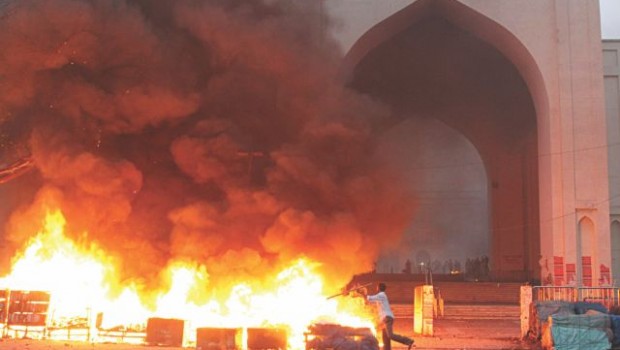
Thousands of radical Hefajat-e Islam men, instigated and bolstered by Jamaat-Shibir activists, exploded into an awe-striking force and set fire to hundreds of shops and police outposts as the evening descended.
Dhaka’s night skyline turned orange, as flames leaped from burning establishments after power supply was cut off. The Hefajat men forced into a parking lot at Dilkusha area and torched at least 50 government buses.
The affected areas were rocked with loud explosion of bombs set off by Hefajat and Jamaat men, while police rained thousands of teargas shells and rubber bullets on the marauding Islamists.
As police and Hefajat men fought on the streets — from Paltan to Bangabandhu Avenue, and from Motijheel to Bailey Road — at least three people were killed in the violence.
A few thousand shops, including jewellery, electronics and furniture outlets, were looted at Paltan, Baitul Mukarram and stadium markets.
Hefajat had earlier promised to hold a non-violent rally at Shapla Chattar to protest what it called anti-religion write-ups by “atheist bloggers” and press home its 13-point charter of demands, including introduction of a blasphemy law.
But it eventually turned nasty after police tried to block a procession of Shibir men at Nayapaltan around 11:30am.
The clash there soon spread to Bangabandhu Avenue, as Shibir and Hefajat men tried to attack the Awami League office there around 1:30pm.
Violence broke out in the Paltan area, and the office of the deputy Commissioner (traffic) was set ablaze.
The government issued a warning to the Hefajat men that they either leave the capital immediately or face stern action. But the zealots ignored it and vowed to stay put.
As their Dhaka siege programme was over, Hefajat men started marching towards Motijheel for attending the rally.  Wielding sticks, thousands of men in white robes converged in Motijheel by the afternoon.
CAPITAL TURNS BATTLEGROUND
Large parts of the capital, including Purana Paltan, Baitul Mukarram, Bijoy Nagar, Dainik Bangla intersection, Bangabandhu Avenue and Motijheel turned into battle ground during the mayhem that began in the morning.
Two of the dead were identified as Siddiqur Rahman, 28, a worker of Hanif Paribahan, and Mohammad Nahid, 21, an employee of a shop in Baitul Mukarram area.
The identity of the other victim could not be known.
Meanwhile, a branch manager of an insurance company died of cardiac arrest while trying to escape the violence in Motijheel area.
Kamaluddin Khan, 55, of Desh General Insurance, was on the way home from his workplace in Motijheel in the evening.
Hefajat men vandalised more than 150 vehicles, including 50 buses of the public administration ministry, and set fire to 30 of those at Rajuk Avenue.
At least 10 vehicles were set ablaze last night in Sukrabad, Dhanmondi, Dolaikhal, Sadarghat, Uttara, Malibagh, and Tejgaon industrial area in the capital and two places in Gazipur.
They also torched 100 shops and business establishments in Bijoy Nagar and Paltan areas, and looted shops in Baitul Mukarram market last evening.
The Islamists also set fire to the deputy commissioner’s (traffic-east) office, showroom of Ideal products and office of the Communist Party of Bangladesh (CPB), smashed windows of most of the offices on both sides of the roads from Dainik Bangla intersection to Janata Bank intersection.
More than 5,000 rounds of rubber bullet, teargas canisters and bullet were fired during the clashes, said police.
The clashes followed the explosion of a crude bomb at Paltan around 11:30am, hours before the Hefajat rally began in Motijheel.
More than 200 people were injured in the violence.
Several hundred Hefajat men tried to march towards Gonojagoron Mancha in Shahbagh defying police barricades, said Sheikh Maruf Hasan, deputy commissioner of Dhaka Metropolitan Police (Ramna Division).
When police barred them, they got into scuffles with law enforcers, he said.
Attacks on AL office
Thousands of Hefajat men aided by Shibir activists swooped on the roadside shops in front of Awami League’s central office around 2:30pm.
As the AL men and police tried to resist them, they attacked the AL office. At one stage, police fired bullets from shotguns. Siddiqur, a worker of Hanif Paribahan, sustained severe bullet wounds during the clash.
He was rushed to Dhaka Medical College Hospital where doctors declared him dead.
The doctors said more than 100 injured people, including five police men, were taken to the hospital. Most of them were hit by bullets.
A traffic constable sustained severe burns when Hefajat men set fire to a police box at Bijoy Nagar. The radical Islamists also beat up a constable near Paltan intersection.
During the clashes with police, Hefajat and Shibir activists set off hundreds of cocktails, creating panic among the commuters.
Many people remained stranded in their offices in Motijheel and Paltan areas following the clashes. Electricity supply was cut off in the two areas last night.
The Hefajat men attacked several TV cameramen, including Mohammad Nasir Uddin of Mohana Television, while they were taking video footage of their vandalism.
They also assaulted several journalists, including a female reporter, and torched the toll collection booth on Babubazar bridge in old Dhaka in the evening.
Talking to reporters at his office yesterday noon, Home Minster Muhiuddin Khan Alamgir said Jamaat-Shibir activists mingled with the Hefajat men resorted to violence during Hefajat’s Dhaka blockade programme.
“Hefajat leaders kept constant contact with me. They said no Hefajat men indulged in violence, rather it was Jamaat-Shibir men who, in the guise of them, created anarchy,” said the minister.

 Source : The Daily Star

Saturday, May 4, 2013

Top news of Bangladesh


                                    Hefajat to muscle in


The Qawmi madrasa-based Islamist group Hefajat-e Islam is to lay siege to the capital today.
The organisation claimed that it would mobilise several lakh workers and supporters at Amin Bazar, Abdullahpur, Demra, Jatrabari, and at Kanchpur, Postogola and Babubazar bridges to make the Dhaka siege programme a success.
The organisation has recently been campaigning to realise its 13-point demand that includes stern punishment of “atheist leaders of the Shahbagh movement”.
Hefajat Secretary General Junaid Babunagri told The Daily Star yesterday that their programme would begin at daybreak. He said Hefajat’s ameer Shah Ahmad Shafi would say when to end the siege.
With the country’s main opposition BNP rendering its support to the siege, Hefajat-e Islam yesterday rejected the prime minister’s call to call off the programme.
It said Prime Minister Sheikh Hasina failed to give any assurance in meeting its 13-point demand.
“In her speech, there was an effort to confuse the nation through contradictory and wrong interpretations [of the demands],” said Mufti Fayezullah, joint secretary general of Hefajat-e Islam.
“That’s why, we have decided to continue with the May-5 Dhaka blockade programme,” he said.
Additional Secretary Khandakar Mainuddin of the home ministry said law enforcers would cooperate with Hefajat in holding peaceful rallies at the entry points of the capital.
However, a Hefajat appeal for holding a rally in front of Baitul Mukarram mosque this afternoon was turned down.
Inspector General of Police (IGP) Hassan Mahmood Khandker, who yesterday had a meeting with different deputy commissioners of Dhaka and superintendents of police of different districts surrounding the capital, told The Daily Star that public life would not be disrupted during the siege.
Asked whether people would be able to get in and out of the capital, the IGP said they would try their best to make sure people do not have to suffer.
The organisers of today’s siege hoped that around three lakh people from Chittagong, one lakh from Sylhet and 50,000 from Rajshahi would join activists and supporters of Hefajat-e Islam in Dhaka.
According to sources, many Hefajat adherents, some of whom support different pro-Islamist components of the BNP-led 18-party combine, reached Dhaka over the last two days and had also attended the 18-Party rally at Shapla Chattar in the capital yesterday.
BNP Chairperson Khaleda Zia in her rally speech yesterday asked the audience if they were ready to stay there for 24 hours.
Amid chants and slogans in support of Khaleda’s suggestion, Khaleda said Hefajat’s siege programme was scheduled for today and that was why she issued an ultimatum to the government to meet the opposition demand for restoration of the caretaker government system within 48 hours.
Hefajat had announced the siege programme on April 6 during its rally at Motijheel to press home its demands.
  news source : The Daily Star,Bd

Sunday, February 24, 2013

Governors accompany White House to action automated cuts


Governors from both parties are warning of the damaging economic impact if the White House and Congress fail to reach a deal to stave off across-the-board spending cuts set to take effect Friday.
"It's senseless and it doesn't need to happen," said Gov. Martin O'Malley, D-Md., during the annual meeting of the National Governors Association this weekend.
"And it's a damn shame, because we've actually had the fastest rate of jobs recovery of any state in our region. And this really threatens to hurt a lot of families in our state and kind of flat line our job growth for the next several months."
Some governors were pessimistic about the prospects for a compromise. They said the budget impasse was just the latest crisis in Washington that is keeping business from hiring and undermining the ability of governors to develop state spending plans.
"I've not given up hope, but we're going to be prepared for whatever comes," said Gov. Brian Sandoval, R-Nev. "There will be consequences for our state."
The White House booked several Cabinet secretaries on the Sunday talk shows to detail the potential impact of the spending cuts on the public, from airports to classrooms.
The administration is bracing the country for widespread flight delays, shuttered airports, off-limit seashores and hundreds of thousands of furloughed employees.
Transportation Secretary Ray LaHood said travelers could face delays because the Federal Aviation Administration is in line for $600 million in spending cuts.
"We're going to try and cut as much as we possibly can out of contracts and other things that we do," LaHood told CNN's "State of the Union." ''But in the end, there has to be some kind of furlough of air traffic controllers, and that then will also begin to curtail or eliminate the opportunity for them to guide planes in and out of airports."
There are fewer signs of urgency among congressional leaders, who have recently indicated their willingness to let the cuts take effect and stay in place for weeks, if not much longer.
The cuts would trim $85 billion in domestic and defense spending, leading to furloughs for hundreds of thousands of workers at the Transportation Department, Defense Department and elsewhere.
Defense Secretary Leon Panetta has said the cuts would harm the readiness of U.S. fighting forces.
Obama has not been able to find success for his approach of reducing deficits through a combination of targeted savings and tax increases. House Republicans have said reduced spending needs to be the focus and have rejected the president's demand to include higher taxes as part of a compromise.

 Yahoo news

Friday, February 22, 2013

Deadly Bangladesh clashes over 'blasphemous' bloggers


At least four people have died in Bangladesh in clashes between police and Islamist protesters who took to the streets accusing bloggers of blasphemy. Dozens more were reported injured.
Some were calling for the execution of the bloggers, whom they accuse of insulting Islam.
Last week, blogger Ahmed Rajib Haider was killed outside his home.
The protests come days after authorities blocked some websites for "hurting religious feelings".
In the capital, Dhaka, thousands of protesters from an alliance of Islamic parties went on a protest rally soon after Friday prayers in the country's national mosque.
Police fired rubber bullets and tear gas to disperse protesters who threw stones and vandalised buildings, the BBC's Anbarasan Ethirajan reports from Dhaka.
Similar violent clashes were reported across the country. In some places, there were clashes between supporters of the ruling Awami League and Islamist activists, our correspondent reports.
Following Mr Haider's death last week a series of blog posts described as anti-Islamic have circulated, but their authorship was not immediately clear.
Strike call
The clashes come amid renewed tension over a tribunal judging war crimes committed during the 1971 independence war.
Last week, Bangladesh's parliament amended a law which will allow the state to appeal against the life sentence given by the tribunal to an Islamist party leader.
In recent weeks a group of bloggers, including Mr Haider, had launched mass protests demanding his execution and a ban on the country's largest Islamist party, the Jamaat-e-Islami.
Islamist parties have called for a nationwide general strike on Sunday in protest at the killing of their supporters in recent clashes.
The Islamist party denies being involved in war crimes and says the tribunal is part of a government vendetta against the party.
Human rights groups have said the tribunal falls short of international standards.
Official estimates say more than three million people were killed in the 1971 war which resulted in independence from Pakistan.

Source : BBC